Are manual welds acting as a silent bottleneck in your steel fabrication facility? We see this constantly on the shop floor. The relentless cycle of repositioning massive steel beams wastes precious production time. What should be a seamless manufacturing flow quickly turns into a series of stop-and-start frustrations. Standard 6-axis robots excel at precision work on smaller components. However, they inevitably hit a wall when faced with the sheer scale of modern structural steel. Their mechanical reach is simply insufficient for the continuous work required by long-span fabrications.
In this engineering guide, we explore how a 7 Axis Robot Welding Workstation serves as a transformative solution to these persistent challenges. By integrating a heavy-duty linear floor track, these systems effectively extend the robot's range. This ensures that even the most massive girders are processed with unmatched continuity, speed, and accuracy.
The Shifting Landscape of Heavy Structural Fabrication
The structural steel industry is undergoing a massive operational shift. Driven by a global infrastructure boom and a severe shortage of certified welders, heavy fabrication shops are being forced to rethink their workflows. Historically, automated welding was confined to stationary cells. This approach worked perfectly for compact, batch-produced automotive parts. Yet, it fails miserably when applied to 15-meter bridge girders.
Today, the market trend is moving decisively toward flexible, large-scale open workstations. Fabricators are realizing that bringing the automation directly to the heavy workpiece is far more efficient than forcing massive beams to fit within a confined robotic cell. This mobility not only solves the reach limitation but also drastically reduces overhead crane dependency, transforming the entire economics of the shop floor.
What is a 7 Axis Robot Welding Workstation?
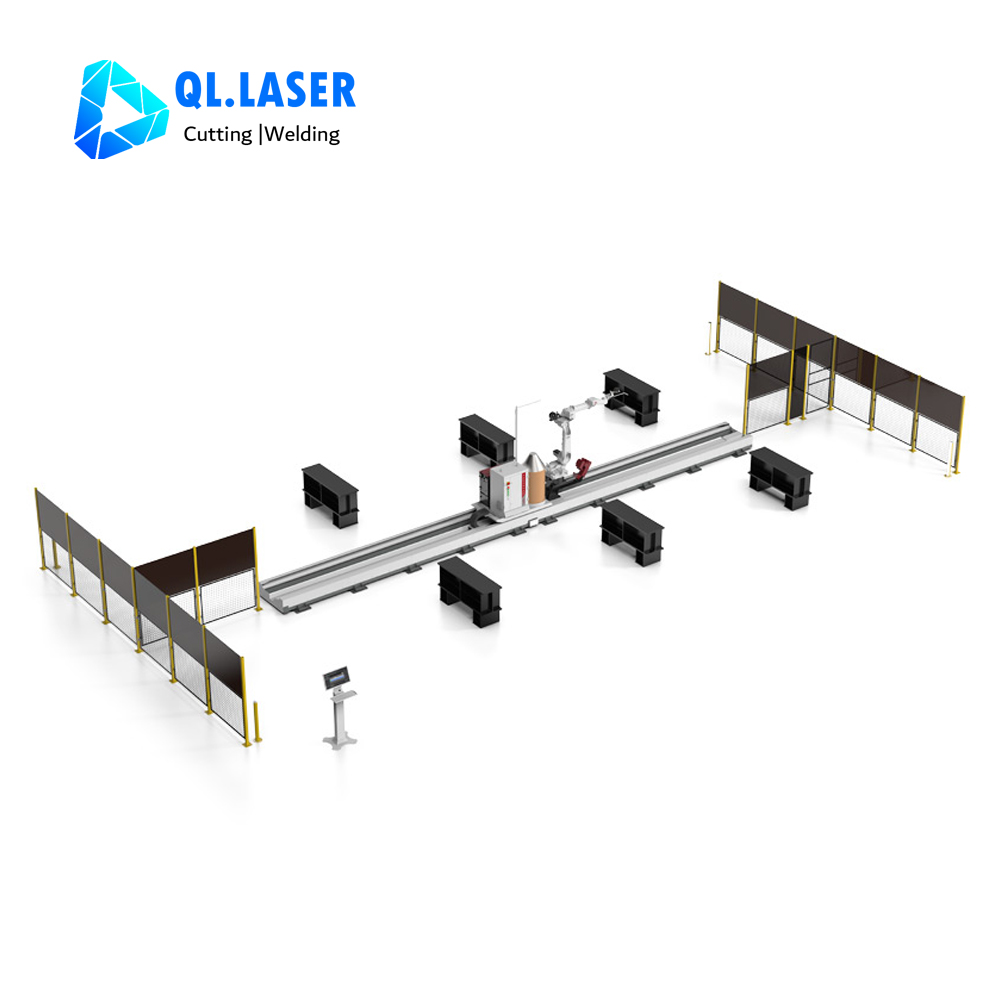
A standard industrial welding robot typically operates with six degrees of freedom. This grants it the spatial flexibility to articulate a torch in almost any orientation. In contrast, a 7-axis workstation introduces a highly critical external axis. This is typically a linear floor track or rail. By mounting the 6-axis robotic manipulator onto this track, the system gains the ability to travel laterally alongside the workpiece. It effectively expands its working envelope from a localized radius to a vast, linear production zone.
How the 7th Axis Works in Synchronization
The true technical brilliance of this system lies in its control architecture. Advanced robot controllers manage all seven axes simultaneously. Utilizing Robot Tool Center Point kinematics, the controller calculates the exact position of the welding wire tip in real-time. This sophisticated synchronization allows the robot to perform seamless, continuous welding while actively moving down the track. It maintains precise travel speed and optimal torch angles without ever needing to pause.
The Core Challenge: Why Standard Robots Fail at Long-Beam Welding
Standard 6-axis robots are inherently restricted by their physical reach envelope. This typically spans between 1.5 to 3 meters. When tasked with welding a 12-meter structural beam, a stationary unit can only access a small fragment of the joint. Once it hits the limit of its mechanical radius, the entire welding process must grind to a halt.
The Hidden Costs of Part Repositioning
Welding long components with stationary automation introduces severe logistical friction. Whenever the robot hits its limit, operators are forced to kill the arc. They must deploy an overhead crane, unclamp the beam, drag it into a new position, re-clamp it, and restart the cycle. This repetitive, non-value-added labor consumes significant time. Furthermore, it introduces struck-by safety hazards across the shop floor.
Start-Stop Defects in Structural Steel
From a metallurgical perspective, interrupting a continuous weld to move a component is a high-risk practice. Every stop and restart creates a potential initiation point for defects. These include cold laps, porosity, or incomplete fusion. In critical infrastructure, these inconsistencies can compromise the mechanical integrity of the entire beam. This often leads to costly failures during non-destructive testing inspections.
Core Comparison: Stationary vs. Rail-Mounted Systems
| Feature | Standard 6-Axis Cell | 7-Axis Rail Workstation |
| Effective Reach | 1.5m to 3m maximum | Modular up to 30m+ |
| Crane Dependency | High. Constant repositioning needed. | Low. Load once, weld completely. |
| Weld Continuity | Interrupted by physical limits | Seamless end-to-end passes |
| Arc-On Time | 40% to 50% | 80%+ |
| Best Application | Small brackets, base plates | Girders, columns, long trusses |
Scenarios Where a Rail-Mounted System is Essential
Evaluating the necessity of an upgrade requires looking at the specific geometry of your shop throughput. The following scenarios represent the most empirically proven use cases for rail-mounted automation in modern facilities.
Fabricating Oversized I-Beams and H-Beams
When manufacturing large I-beams, continuous fillet welds are required along the intersection of the web and flanges. A long-beam robotic welding system travels parallel to the beam, depositing uniform fillet welds across the entire span. This movement helps distribute heat input evenly. Consequently, it effectively minimizes thermal distortion and warping in the final product.
Bridge Girders and Heavy Infrastructure
Infrastructure projects are governed by stringent structural codes like AWS D1.5. Bridge girders require deep penetration and multi-pass precision. A 7-axis system ensures that travel speeds remain mathematically locked over long distances. This guarantees code compliance while removing the human fatigue associated with long-duration manual passes.
Multi-Station Welding Setups
A single rail system can service multiple distinct workstations. Often called pendulum welding, this setup allows the robot to weld a component at Station A while human operators prep the next load at Station B. Once the robot finishes its work at the first station, it glides smoothly down the track to begin the next task. The machine is never left idle.
High-Mix Low-Volume Structural Fabrication
There is a persistent misconception that robotic automation is exclusively for high-volume automotive lines. In reality, modern 7-axis systems excel in high-mix environments. By utilizing offline programming software, engineers can generate weld paths directly from 3D CAD models. This allows the robot to transition from a custom structural frame to a standard beam with negligible changeover time.
Manufacturing Long Trusses and Crane Runways
Assembling complex, lengthy frameworks like overhead crane runways requires accessing multiple nodes spread across a vast area. The extended linear reach of the 7th axis allows the robotic arm to navigate around intricate lattice structures. It accesses difficult-to-reach nodes without requiring the entire massive assembly to be rotated by a crane.
Engineering Criteria for Selecting a Rail System
The transition to a Structural Steel Welding Robot is not merely about changing the machine. It is about changing the economics of the fabrication process. When specifying your equipment, abstract features mean nothing. You need concrete engineering standards.
Heavy-Duty Linear Rails and Payload Capacity
The rail is the foundation of your accuracy. It must feature high-precision ground helical rack and pinion drives for repeatable motion. Standard industrial tracks should support payloads ranging from 500kg to over 2000kg to comfortably carry the manipulator, wire feeders, and heavy welding power sources. Furthermore, look for industrial-grade debris protection. Heavy-duty steel bellows are necessary to prevent abrasive weld spatter and grinding dust from infiltrating the mechanical heart of the track.
Advanced Laser Seam Tracking Technology
Structural steel is rarely perfectly straight. Mill tolerances and thermal warping are a fact of life. Therefore, laser seam tracking is mandatory for long-span work. These systems scan the joint in real-time. They allow the robot to dynamically compensate for deviations, ensuring the weld stays centered regardless of imperfections in the raw steel.
Offline Programming Capabilities
To keep the machine moving, prioritize CAD-to-path offline programming software. This allows your welding engineers to program tomorrow's project while the robot is still welding today's beam. It effectively eliminates expensive machine downtime for manual teach-pendant programming.
ROI and Production Impact: Is the Investment Worth It?
To justify the capital expenditure, facility managers should document the hidden costs of their current workflow. Calculating the labor hours lost to crane wait-times and rework cycles often reveals a shocking amount of waste. A Rail-Mounted Welding Robot pays for itself faster than anticipated through sheer efficiency gains.
Profitability is directly tied to arc-on time. This is the percentage of a shift that the torch is actively depositing metal. Manual welding on large steel often yields an arc-on time of only 30 percent, as the welder spends hours grinding and maneuvering. By eliminating crane delays, rail-mounted systems can drive this metric well above 80 percent.
Additionally, this workstation acts as a force multiplier. It empowers a single operator to manage the production volume of three or four manual welders. This effectively insulates your shop from labor market volatility and the tightening shortage of skilled tradespeople.
Implementation Steps for Your Fabrication Shop
Successful integration requires more than just bolting hardware to the floor. It demands a strategic engineering approach to your shop environment.
First, assess your floor space and material flow. A rail system demands dedicated, linear space. Ensure your concrete foundation meets strict leveling and thickness requirements. Any floor undulation can compromise precision over a 20-meter track. Plan your logistics so that overhead cranes and forklifts can feed the station without interrupting the robot's active cycle.
Second, train your workforce appropriately. The success of automation rests on your team. Rather than fearing replacement, your current welders should be empowered. By training your most skilled manual welders to become robot operators, you leverage their deep knowledge of metallurgy and puddle control to optimize the machine's performance.
Conclusion
While standard stationary robots have their place, they cannot compete with the demands of heavy, long-span structural fabrication. The industry is moving toward greater mobility and automation to combat labor shortages and mechanical reach limitations. A 7-axis workstation is more than just a piece of equipment. It is a fundamental shift in how you scale your production capacity and ensure consistent, high-quality results.
If you are ready to stop moving steel and start moving your business forward, you need equipment engineered for the reality of heavy fabrication. Explore the full range of intelligent solutions at QL Laser to find the exact rail-mounted system that matches your production goals and facility requirements.
Frequently Asked Questions
How long can the track of a rail-mounted welding robot be?
Tracks are highly modular. While standard lengths range from 5 to 20 meters, they can be extended almost indefinitely depending on your facility floor space and the maximum length of your structural components.
Is it difficult to program a 7-axis robot compared to a 6-axis robot?
Not with modern software. Advanced controllers and offline programming suites automatically calculate the synchronization between the robotic arm and the linear rail. This makes the programming of complex, long-reach welds seamless for the operator.
Can a 7-axis robot handle structural steel with mill scale or rust?
Yes, provided the system is configured correctly with the right power source and welding wire. The inclusion of laser seam tracking is critical here. It allows the robot to dynamically adjust to any surface imperfections or warping present in the raw structural steel.
Does a long-beam robotic welding system require a dedicated operator?
It does, but the labor efficiency is vastly improved. A single operator can manage the entire system. While the robot performs active welding on one end of the rail, the operator can safely load or tack-weld parts at the other end. This ensures continuous, high-output production.
What is the typical ROI timeframe for a 7-axis rail system in structural steel?
For heavy fabrication shops running two shifts, the return on investment is typically seen between 14 to 24 months. This rapid payback is driven by the massive jump in arc-on time and the drastic reduction in overhead crane bottlenecks.
How does a rail-mounted robot handle thermal distortion during long continuous welds?
Continuous welding introduces significant heat input. Rail systems combat distortion by utilizing laser seam tracking to follow the warping metal in real-time. Furthermore, the robot can be programmed to perform stitch welding or alternate sides of a long beam automatically, distributing the heat evenly to keep the girder straight.